Tuesday, June 3

Sharks - Sustainable Predators

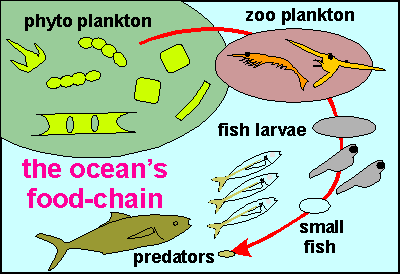
The movie, Sharkwater, is a desperate plea to the world to stop the shark finning industry from destroying the ocean's top predator, not only for the sake of biodiversity, but for the survival of humankind. Sharks have sculpted the marine ecosystems for 400 million years, pressuring evolution in all of its prey. Removing sharks from the ocean (which at the rate they are being killed now, isn't that far away) destroys a very well established food web...if sharks are gone, there will be a marked decrease in predation on smaller fish; the increase in the smaller fish populations will desimate the phytoplankton populations; which will in turn harm us because phytoplankton are responsible for providing the atmosphere with about 70% of its oxygen; less oxygen is not a good thing for humans...let alone everything else.
The ocean's top predator is a keystone species to human survival on Earth

But there are two major factors that keep the shark finning industry alive and strong: 1. culture and; 2. fear.

Most sharks are killed for their valuable fins, used for shark fin soup in much of Asia, particularly China. Although it isn't very flavorful, people pay up to $90 a bowl because it is considered a delicacy. It is a status symbol and is reputed to transfer the good health and long life of sharks to the consumer.
Often flavored with chicken or pork, shark fin soup is the cause of the destruction of 90% of the global shark population

Whether it was Jaws or something else, sharks have such an awful reputation as brutal, mindless killing machines, that the thought of them is enough to keep some people out of the ocean. I remember being terrified of them as a child, even though I had never seen one in the wild (and still haven't!). Changing their reputation is not easy, because in the end, they can sneak up on you and have really big teeth. The fact that they are highly evolved fish with two more senses than us doesn't mean much...they have really big teeth.
This sort of BS photography doesn't help to convince the more gullible that sharks are not mindless killing machines

So the two things that put sharks, and ultimately ourselves, in danger are two things that are really hard to change. One culture is rarely in the position to judge another culture, but looking at biology rationally would help alleviate the myths associated with culture. And education is the only thing that might eventually convince people that our preconceived notions are false. People will still get bit by sharks, but remembering that we are imposing ourselves on their territory might remind us that we don't have the right to go out and kill them all.

I like to think that building community and social capital is not limited to the human sphere. Putting ourselves in our proper place in the webs of life, as one part, not a whole unto ourselves, we may begin to see the benefit of and connectedness of all life.

Saturday, May 31

Spirituality and Sustainable Development

I've looked through a portion of the e-dialogue on Spirituality and Sustainable Development from June of 2002. Separately, these are topics that I not only find intriguing but necessary. Together, they ask me to think about what is necessary for SD.
Dr. Dale begins the dialogue by asking the participants to comment on what spirituality is, these are a few "definitions" that spoke to me:

1. related to 'wonder and awe' or marveling at existence, and a recognition of sacredness in all life and thus a protection of existence - which translates into justice.

2. To me the spiritual is beyond "good" and"bad". In fact I suspect that it is beyond all binary opposites. It simply IS. Therefore of course impossible to use the normal scientific method to know. Hence it's bad scientific press.

3. To me spirituality is the deep connection we possess with our Mother the Earth and all of her children. It is felt in our respect of all our brothers and sisters of creation, of our ancestors and of the faces yet to come.

4. I believe spirituality is mine and everyone else's connectedness to all that exists, even that which we do not recognize or that is beyond our consciousness. This includes an intangible (an Energy, a Creator, a Sustainer, a Great Mystery....) which exists within and without all of us and creation, which is immeasurable and ultimately greater than the sum of its parts. What name we put to that, or however many names, we still are one. Only our quest divides or joins us.

My own definition of spirituality is the understanding that as individuals we are connected to the "whole," we are not separate. My God therefore, is the "whole." I do not believe in a being that reigns from on high, but I do believe in a common energy that links everything in the universe and beyond. My spiritual practice, the latihan, links me to God in a personal context that I can feel any time I am quiet. I believe that part of my dedication to trying to live "sustainably" is because I know what it feels like to be connected to the "whole." And like I said, I cannot separate myself, or anything, from the "whole." I don't want to say that having a sense of spirituality is necessary for SD, but when people can see themselves as part of something beyond their own lives, I think there is a greater chance that they will care. And I think caring is a big part of the equation.

Doomed to repetition

In The Serpent and the Rainbow, by Wade Davis, there is a description of the slave revolt against the French rulers in Haiti, in the chapter titled "Tell My Horse." He writes, "by the last years of French rule, it was patently clear to all that the greed of the entire system had set the colony on a path of self-destruction. Only the potential for massive profits could possibly have numbed the whites to the imminent disaster" (p.201). The atrocities committed by the European plantation owners on the black, white and mulatto slaves was as bad as those on the people of Hispanola when Columbus arrived and realized there was gold to be had. I'm sure they can be compared to those wrought on the people in Rwanda, Aboriginals from the Americas, and countless other examples across the globs and across time. With plantations reaching further and further up the hills and down the valleys in Haiti to supply the world with its demand for coffee and sugar, plantation owners could only see the growing stacks of money and the beauty of an endless supply of slaves. I'm only picking on them because I happen to be reading the book right now, but they are not unique...the British Properties in West Vancouver slowly creep up the mountains in search of a better place to put the next mansion with a better view, and wilderness in the backyard. Why is it so hard for us to see our past mistakes? In a time when information is so easily accessible, when so much is documented, why do we fail to remember? Was it too long ago? Too removed from us, personally? Or is it that we don't care? I am sometimes flabbergasted at my own inability to learn life lessons, so I know I do not fall outside the realm of human failings, but I can't help but wonder why. I would like to think that we are evolving as a species, that in time we will (as a whole species) be sustainable. Sustainability is not possible with such massive human rights abuses.

Wednesday, May 21

call me "tree-hugger"


It's true, I can't deny it any longer, I'm a hippie...a stinky, earth-loving, tree-hugger. I don't think it serves anyone or anything to stereotype, so I wouldn't say that I'm proud of my designation, but if someone really wanted to pigeon-hole me, that's probably where I'd end up. I'm one of those "ecocentrists" who believes that all life on earth was created equal and that the earth has intrinsic value. I struggle between thinking that humans have just gone and messed everything up (fine, call me a Social Green, too) and that we're just playing our part in an endlessly evolving game of Life. I appreciate simplicity, and feel that our eventual downfall will be that we've made everything too complicated: our social, economic and environmental spheres can no longer overlap because each is too entangled in its own web of confusion. But I'm way more moderate than a radical, I don't think humans are the end-all-be-all that have the power to destroy the planet...oh no, I'm quite confident that the planet will survive, regardless of human action. That gives me hope. What gives me motivation is the desire to not be that lame one in the group that messes it up for everyone else. Not just because I don't want to be lame, but because generations of people and plants and animals should have all the same privileges as I have. I think all creatures are greedy, but only humans are greedy for things that we don't need.

Sunday, May 11

last summer's attempt at sustainability


So....last summer I started my own little business in an attempt to enjoy the summer, the beach and my last weeks of freedom before heading out to RRU. I'm including the blog address here so that if you want you can check it out. It is just as much about sustainability and community relations as this blog could ever hope to be. However, it wasn't exactly written as a school assignment, so if you do check it out, check it out as a curious bystander not as a professor. Thanks.

http://zuzuslemonade.blogspot.com/

Coopetition

At the RRU Earth Days trade show, I spoke to a man who was representing the The Green Collective: a collective of ten Victoria businesses who have sustainability in common. He told me that although they are competitors in the "niche" market of environmentally friendly products, they support each other because they see the environment as just as important as their businesses. In this sense, as cooperative competitors, they practice "coopetition." This little idea spoke to me because I've always been one of those people who would prefer it if everyone could win, no one got left out and people with good ideas were listened to. When I worked in retail (shhhh, don't tell my old boss!) I would inform customers if there was a sale on at another store, or tell them to go to the store with a superior product...no wonder I never made much in commission! As a consumer, I want businesses to be frank, open and honest about what I am purchasing, and if something better exists, I want to know. The guy at the trade show, whose name I can't remember, said the same thing: if one of his customers asks for something that he can't provide, he will refer them to one of his coopetitors. It's a win-win situation, because he has actually provided the customer with something, honesty. I know for myself that this small action would keep me coming back to his store. I respect integrity, and will give him my business in the future.

Oct. 2, 2003, is a memorable date for me...it was the last time I shopped at Wal-Mart. I had been wanting to quit for awhile, but the universe kept pulling me back into a cycle of convenience and apathy. I don't remember if I consciously said, "this is it, the last time I'll shop at Wal-Mart," but at some point I had committed myself to breaking the cycle. In the long run, it's a pretty tiny, unimportant act of consciousness, that will probably have no affect to anyone, including Wal-Mart, except to myself. But it is something, and something that once started isn't all that difficult to maintain...actually, I've never once had to talk myself down from a remission. And, secretly I'm really proud of myself. Just like I'm proud that I have never used a takeout coffee cup from the Habitat...a commitment that only means something to me, but for me it is a statement of sustainability.

I can't imagine that the Green Collective and Wal-Mart have much in common, but they come together in my mind as two ends of a spectrum of sustainability. One the one side, the Green Collective is ten small, local shops that source local products and care about the environment. On the other side, Wal-Mart is a multinational corporation that sells cheap products, made far away, that will need to be replaced in not so long. I choose the Green Collective because there are faces to the businesses, and they are people trying to do a good thing and make a living while they are at it.

Tuesday, May 6

Canada's first Multiversity?


The Mpambo Afrikan Multiversity is in Kampala, Uganda...or as Paolo Wangoola described, at the source of the Nile River, on the banks of the Lake of the Goddesses. The Multiversity is different than a university because it acknowledges that there are many (multi) truths to knowledge, not one (uni), Western truth. It is an institution of higher learning that is conducted solely in the mothertongue of the people it serves, Luganda. The professors are those in the community who are deemed the most knowledgeable about one of the areas of study...they may never have been "educated" in the Western sense, but are the premier experts in their field...as decided by the community. The focus is on engaging people in the language that they use everyday, that they think in and dream in. How can someone contribute to an intellectual dialogue when they do not know the words they need? How can a society, so battered and beaten as Africa, ever hope to pull themselves up if they are continually excluded? And how can they be INCLUDED if no one is allowed to be educated in their own language? English has become the dominant language around the world, but it is based on a vertical hierarchy: English is at the top, and every other language is below it...is inferior. What the multiversity does is puts learning on a horizontal scale, where all languages, all types of learning and teaching are equal and different.
The multiversity isn't just about learning in your mothertongue, it is about learning what is applicable to where you are, namely Africa. They have four main programs: Afrikan Spirituality and Philosophy; Medicine; Food and Agriculture and; Black Awareness. These are programs that will empower the learners, not underline their differences. The multiversity is raising funds to build a new "cave," the House of Indigenous Cultures and Spirituality. It will be the centre-piece of one of the campuses, that will be used for meeting spaces, residences, a library and a bookstore.
The multiversity has huge implications for sustainability, not only in Africa but the rest of the World as well. Even in the most basic definitions of sustainability, from the Brundtland Report, future generations need access to the same things we have access to now, including language and culture. There is nothing sustainable about homogenizing the world; we know it doesn't work with crops, why experiment on people? Is Canada sustainable enough to start a multiversity? Royal Roads prides itself on being an institution that is doing things differently than the rest...but really, are we all that different? There has been no paradigm shift, just a general difference in styles. The multiversity is a paradigm shift, and that seems to be the key to a sustainable future.
Watch a video here:

Thursday, May 1

Biofuels

I enjoyed the mock Future Search Conference that we participated in a couple weeks ago. The biofuels issue was timely and interesting. Since the conference, I have heard about biofuel issues quite a lot of the radio, from skyrocketing grain prices to booming beetle-kill tree industries. During the conference we decided that we shouldn't clear beetle-kill trees to burn for fuel because of the damage to the ecosystems. But since then I have heard more about it on the radio, and feel that it might not be such a bad idea. Although I do not support clear cutting the dead trees, I do think that selective thinning could help the economies of poor interior communities. I still don't think that growing biomass just for fuel is a good idea...we need to get off fuel!!

Monday, April 21

Earth Days

Tuesday, April 22nd is Earth Day. I love celerbrating the Earth, because I love the Earth. I don't necessarily think that one day a year is sufficient celebration, but it is a start. I hope that in time Earth Day becomes everyday. If everyone starts thinking about their actions in relationship to the Earth, we'll be leaps and bounds closer to living sustainably.

Part of our celebrations at Royal Roads is the ceremonial planting of three trees. I volunteered to say a few words about this ceremony for those who participate. This is what I will say:

"Welcome to this ceremonial tree planting in honor of the Earth.

This week we are celebrating the Earth; its bounty and our responsibility to it.

This land, where we stand now, and where a lot of us spend most of our days, has supported life for millennia.

It has seen the passing of ages, the ebb and flow of countless tides, the scouring work of glaciers.

The tapestry of the past is woven by the ocean and streams, the wind, and both the inner and the outer fires. And IN the tapestry is all life: the plants, the animals, and even the fungi and bacteria.

And of course, the people, who have also been here for a long time. These are the traditional lands of the Esquimalt and Songhees First Nations. And we pay tribute to them today.

In the fertility of such a rich past, blooms the present. The students, staff, faculty and other community members; all of us visitors to this place of learning, and of discovery. This is a place to become, a place to remember.

OUR future may be uncertain, but this land will persist. The future holds yet untold stories, generations of people, of animals and of the long-lived trees.

It is the trees that represent the eons of this land, and the human qualities which we seek.

Trees represent knowledge, and it seems appropriate that this university is surrounded by them.

They represent wisdom, with roots that hold them strong to the earth, to their foundations. They stretch tall, seeking the light.

And so, in honor of the Earth, we plant these three trees, which represent the past, the present and the future of this land.

Something that Greg Sam said to our class last week stuck with me. He said that his people live with the land. Not ON the land, but WITH it. If there is one thing to keep in our minds this week, while we are celebrating, it is for each of us to try to live with the land."

Although I am slightly pessimistic about the amount of people that will show up for all the events we have planned, I think it is so important to make a big deal about Earth Day. We can provide the opportunity, but we cannot force anyone to learn. I'm happy to provide. I'm also happy that these days of events have the potential to lead to community development. I get so wrapped up in my own cohort and work, that I don't even give thought to the other cohorts on campus. I hope that some of these people will participate and our social capital will expand as we get to know each other. If we cannot be united in our learning, maybe we can be united in our passion.

Sunday, April 13

Community Livability Survey

These were some of the main themes I took out of the survey:
  • Methods of travel
  • Safety concerns
  • What is available
  • Walkability
  • Connection
  • Volunteer opportunities
  • Diversity of social opportunities
  • Community involvement
  • Trust in media
  • Acceptance in community
I think these are interesting because it goes to show how many different aspects of a "community" there are. Having a sense of community is very important to me, but there were some aspects of the survey that I had never really considered before, such as which media outlets I trust (none! well, except the CBC radio a little) and the connections of the community. Eventually, when I decide where I want to put down some roots, I will consider a lot of these factors, but it really wasn't until going through the survey that I realized how much I would not have considered...just because I didn't recognize the need. For example, I know that if I end up living in an urban setting, walkability and accessibility to various services are a must. But will I walk around to the potential neighbors and see what their ethnic backgrounds are or if they are associated with any "questionable" groups (like NAMBLA!)? Probably not, thought I certainly see the wisdom in it.

The exercise we did in class on April 10, in which we spoke with our group about our own sense of connectedness, was interesting for me. As I said last week, I don't feel particularly a part of the Langford community because I feel transient, so I also don't feel very connected. I do have a lot of connections through the school and my cohort, but in my personal life the connections are definitely lacking. One team member suggested that he feels the same because he doesn't see any point in putting a lot of effort to build a community here when he knows he'll be leaving fairly shortly. I kind of agree with him. But then another classmate said that he feels that line of thinking is lazy and a bit of a cop out, because even if we are here for a short amount of time, there is definitely enough time to get involved and be a part of the community. The investment is worth putting the effort in. This made me think that my community is really what I make of it. I could be doing a lot more to make living in Langford a meaningful experience.

Saturday, April 5

Langford = Community?

I'm not even sure that I live in a community. I feel like I just live in a neighborhood. I like my neighborhood, at least the way it looks, with a lot of big trees and houses that are all more or less different than the one next door. But community? Granted, I consider myself somewhat transient; I have no intentions of staying here when I'm finished with school. There could be a rich community that I don't know about because I haven't bothered to look for it.

So what is my definition of community?
  • People know each other in a community;
  • there are community events;
  • there is something that ties people together, whether it be where they live, what they are interested in or issues that unite them and;
  • there is cooperation, trust, and empowerment among community members.

I've noticed that in the mall near where I live there are often events, and they do draw community members. There is an Earth Week celebration coming up, focused on teaching kids about sustainability...at a mall. I am all for teaching kids about sustainability, but there is something depressingly contradictory about doing it at a mall. Despite the place, at least there are events that bring community members together. I would be curious to ask long time residents if they feel they are a part of a community. I feel that my strongest communities are smaller than the "suburb" level, they are the intimate communities based on a shared passion. If other people feel like Langford is a community than it is, even if I don't feel a part of it.